How many letters are in the Thai alphabet?
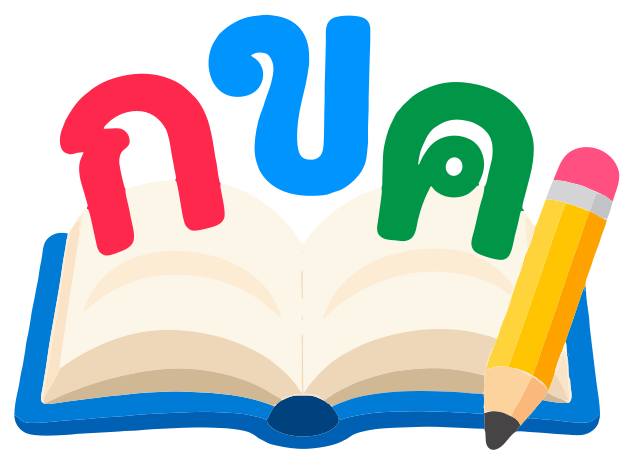
The Thai alphabet has 44 consonants, and Mooteach teaches every one with its name in a male and a female voice.
Two of them, ฃ and ฅ, are no longer used, so 42 appear in everyday writing. On top of these come 32 vowel forms, four tone marks and a few other signs. Thai has no capital letters, and words are written without spaces between them.
Why does every Thai letter have a name?
Every Thai letter has a name because several letters share a sound, so the name says which one you mean.
Each consonant is named with a word that starts with it, the way an English speaker might say "A for apple". ก is gor gài, "chicken", and ข is kǒr kài, "egg".
What order should I learn the Thai consonants in?
You should learn the Thai consonants by class, middle first, then high, then low, practicing each with Mooteach's alphabet reference and writing practice.
- The nine middle-class consonants. Their tone rules are the simplest, and they let you read your first syllables.
- The high-class consonants, eleven of them, which come in pairs with low-class letters that share their sound.
- The low-class consonants, the largest class, starting with the common ones.
- The rarely used letters last: you will meet them in only a few words.
What are the nine middle-class consonants?
The nine middle-class consonants are the letters below, the ones Thai learners start with because their tone rules are the simplest.
The last two are rare forms of the d and dt sounds. Select any letter to see its page and hear its name.
How do the consonant classes affect tone?
The consonant classes affect tone by deciding, with the vowel length, the final sound and any tone mark, which tone a syllable takes.
The class does not change a letter's sound. That is why Thai learners learn each letter with its class. How Thai tones work has the full rules.
What are all 44 Thai consonants?
Here are all 44 Thai consonants by class, each with its sound at the start and the end of a syllable.
Each letter's sound is given at the start of a syllable and at the end, where many letters take a different sound. At the end of a syllable the consonants fold into just eight sounds: k, t, p, m, n, ng, w and y.
Middle class (9)









High class (11)










Low class (24)






















Which Thai letters look alike?
The Thai letters that look alike are pairs that differ by one small detail.
The detail is a stroke that rises above the line, a notch, a tail, or where the head sits. Learn these side by side, and say each one's name as you compare them.
Each letter's page lists the letters it is most easily confused with.
How do Thai vowels work?
Thai vowels are signs written before, above, below or around a consonant.
A vowel written before its consonant is still said after it. There are 32 vowel forms, most of them in short and long pairs, and the length can change the meaning of a word. The four tone marks and five other signs are on their own page: Thai tone marks and special characters.
How do you write the Thai alphabet?
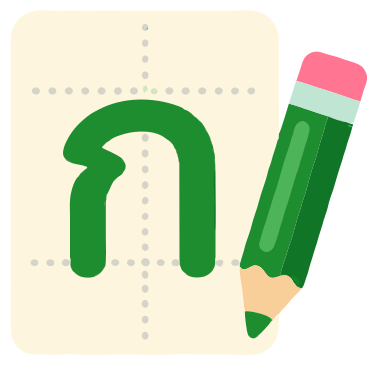
You write the Thai alphabet by starting each consonant at its head and drawing it in one stroke.
The head is the small circle most consonants have. How to write Thai letters shows every consonant drawn stroke by stroke.
What is the best way to memorize the Thai letters?
The best way to memorize the Thai letters is a few a day, by class, said out loud, written and reviewed, and Mooteach's writing practice has you write each one from memory.
- Learn three to five new letters a day, by class, starting with the middle class.
- For each one, say its name, its sound and its class out loud, and write it a few times.
- Review the letters from the days before first, before adding new ones.
- Use flashcards that bring back the letters you miss more often than the ones you know, the idea behind spaced repetition.
- Find each new letter in a word you already know, and read short words early.
Should I learn the Thai alphabet or use romanization?
You should learn the Thai alphabet, and Mooteach lets you lean on romanization only until you're ready to switch it off.
Romanization helps you speak in your first weeks, but every book and app spells Thai differently in Latin letters, and most spellings leave out the tone. The Thai script shows the tone and the vowel length, and it is what you will see on signs and menus. Reading Thai romanization explains how to use it as a bridge.
How long does it take to learn the Thai alphabet?
Learning the Thai alphabet takes a few weeks at ten to fifteen minutes a day to recognize the common consonants, a pace Mooteach's short lessons make easy to keep.
Reading whole words takes longer, because it adds the vowels and the tone rules. Short daily practice works better than long, occasional sessions.
Is there an app for learning the Thai alphabet?
Yes, there is an app for learning the Thai alphabet: Mooteach, which teaches it as part of a full Thai course, so every letter comes with words you can say, its name in a male and a female voice, and writing practice from tracing to writing it from memory.
See how Mooteach compares with other Thai apps.